Price Match vs Voucher Code: Which Should You Choose?
A practical head-to-head comparison of Price Match and Voucher Code, covering quick verdict, key differences, category winners, buyer fit, and FAQ.
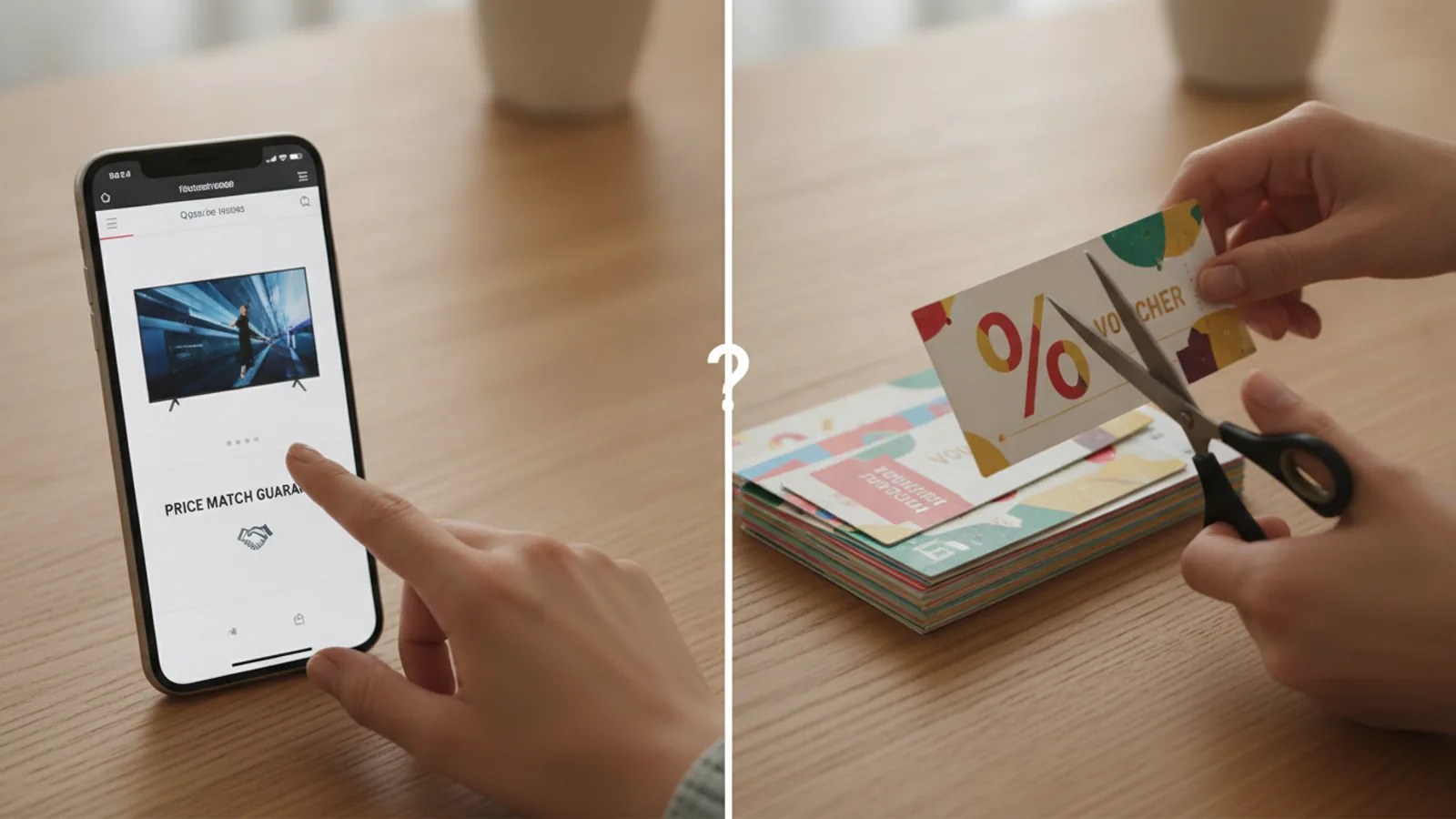
Price Match vs Voucher Code: Which Should You Choose?
Head-to-head comparison
Overall winner: Voucher Code for its sheer convenience and wide availability.
For the vast majority of UK shoppers, voucher codes offer the most practical, immediate, and accessible way to save money. They are simple to find and apply to a wide range of purchases. Price matching is a powerful tool for dedicated bargain hunters making a specific, high-value purchase, but its strict conditions and the effort required make it a niche strategy rather than an everyday saving method.
This comparison is based on our extensive analysis of UK retailer policies, discount code databases, and the real-world shopping habits of cost-conscious consumers in 2026. We've examined the terms and conditions of major retailers to give you a clear, evidence-based view of which saving method delivers the best results.
At first glance, getting the lowest price seems simple. But the choice between securing a price match and applying a voucher code involves a crucial trade-off between the depth of the discount and the effort required to get it. A price match promises the absolute lowest price on a specific item by matching a competitor, but it demands research and adherence to strict rules. A voucher code provides an instant discount directly from the retailer but may come with exclusions or a lower overall saving. The best choice isn't automatic; it depends entirely on what you're buying and how much work you're willing to do.
Option A
Price Match
- Best for: Major purchases like TVs or appliances
- Strength: Highest potential saving on a single item
- Tradeoff: Requires significant research and strict criteria
Option B
Voucher Code
- Best for: Everyday shopping and instant discounts
- Strength: Widely available, flexible, and easy to use
- Tradeoff: Often has minimum spends or product exclusions
Head-to-Head Scorecard
Price Match vs Voucher Code: Key Differences
Understanding the fundamental difference between these two savings methods is key to using them effectively. They are not interchangeable; they represent two distinct approaches to getting a better price.
A Price Match (or Price Promise/Guarantee) is a policy where a retailer agrees to sell you an item for the same price as a competitor. This is a reactive discount. The power lies with you, the shopper, to find a cheaper, identical, in-stock product at a qualifying competing store. The retailer is simply matching that price to secure your business. The process typically involves providing proof (like a link to the competitor's product page) either before purchase or, in some cases, for a refund of the difference shortly after. The onus is entirely on the shopper to do the research.
A Voucher Code (also known as a discount code, promo code, or coupon code) is a proactive discount offered directly by the retailer. It consists of a string of letters and numbers that you enter into a box at the online checkout to receive a specific reduction. This could be a percentage off (e.g., 20% off), a fixed amount off (e.g., £10 off a £50 spend), or an offer like free delivery. These codes are created by the retailer as a marketing tool to drive sales, clear stock, or reward customers. They are widely distributed through newsletters, affiliate websites, and browser extensions.
The core distinction is control and origin. With price matching, you control the discount by finding the benchmark price. With a voucher code, the retailer controls the discount, setting its value and all associated terms.
Measurement
Routine fit winner
When it comes to fitting into a regular shopping routine, there is no contest. Voucher codes are built for everyday use. They are ubiquitous in online retail, with dedicated websites, browser extensions, and email newsletters constantly promoting new offers. Finding a code for a planned purchase often takes less than a minute. You can search for a code just before you checkout, making it a low-friction, high-frequency saving tactic.
Price matching, by contrast, is a special-occasion tool. It's a structured process reserved for a smaller number of retailers, primarily in sectors like electronics and home appliances (think Currys, John Lewis & Partners, Richer Sounds). It requires you to actively compare prices across multiple approved competitors for a single, specific product. This isn't something you do for your weekly grocery shop or a new pair of jeans; it's a deliberate, research-intensive task best suited for significant, considered purchases. Because of the effort involved and the limited number of participating retailers, it simply doesn't fit into a routine shopping habit.
Measurement
Formula or feature winner
This metric assesses the maximum potential saving each method can deliver. While a 15% or 20% off voucher code feels great, its power is capped by the percentage offered. A price match, however, has a much higher theoretical ceiling for savings. Its "formula" is simple: it matches the lowest price you can find from a valid competitor.
Imagine you want to buy a new television with a Recommended Retail Price (RRP) of £1,500. You have a 10% off voucher code, which would save you £150. However, you discover a legitimate, competing retailer has the exact same model on a 24-hour flash sale for £1,100. A successful price match would save you £400—more than double the saving from the voucher code. This potential for deep, specific discounts on high-ticket items is where price matching truly excels. The saving isn't a fixed percentage; it's the entire difference between your retailer's price and the competitor's, which can be substantial during major sales events like Black Friday.
Measurement
Ease of use winner
Ease of use is about minimising friction between finding a deal and actually seeing the discount in your basket. Voucher codes are the undisputed champion of convenience. The process is streamlined and universally understood: find a code, copy it, paste it into the promo box at checkout, and click 'Apply'. The discount is confirmed instantly. Modern browser extensions like Honey or Pouch can even automate this process, finding and testing codes for you.
Price matching is a far more manual and cumbersome process. It typically requires you to:
- Find a cheaper price for an identical, in-stock item.
- Check if the competitor is on your retailer's approved list.
- Fill out an online form, start a live chat, or call customer service.
- Provide a direct link or other proof of the competitor's price.
- Wait for a member of staff to verify the claim.
This can take considerable time and effort, and there's no guarantee of success. If any of the strict criteria aren't met (e.g., the competitor is out of stock, the model number is slightly different), the request will be denied. The simplicity of a voucher code makes it vastly more user-friendly for the average shopper.
Measurement
Value winner
Determining overall value requires looking beyond the maximum discount to consider flexibility and consistency. While a price match can deliver a bigger one-off saving, voucher codes often provide better cumulative value across more shopping scenarios. A price match is laser-focused on one product. You cannot price match your entire shopping basket item by item.
Voucher codes, however, are frequently more flexible. A "15% off everything" or "£20 off when you spend £100" code applies to your entire order, potentially discounting multiple items from different categories at once. This broad application is incredibly valuable for general shopping trips. Furthermore, voucher codes can sometimes be stacked with existing sale prices. A retailer might discount an item by 30% on their site, and a valid 10% off code could potentially be applied on top of that sale price, creating a compound discount. This sort of "double dipping" is impossible with a price match, which establishes a single, final price based on a competitor.
Measurement
Buyer confidence winner
Buyer confidence relates to the reliability of the discount and the certainty of achieving the desired outcome. This is a surprisingly complex area. Voucher codes can be a source of frustration; we've all experienced the disappointment of an "expired" or "invalid" code at the final stage of checkout. Codes often have complex exclusions (e.g., "Excludes Apple products and consoles") that are only discovered upon application.
A price match, while harder to secure, offers a powerful guarantee once approved. The policy's entire purpose is to give you confidence that you are not paying more than you have to. When a retailer like John Lewis & Partners approves a price match, you have a firm assurance that you are getting the item at the lowest price available from its main high-street competitors. There's no ambiguity. The process is transparent (if demanding), and the result is a guaranteed price floor. This certainty provides a level of buyer confidence that the hit-or-miss nature of voucher codes can't always replicate. The effort leads to a more concrete and reliable result.
Choose Price Match If...
- You are making a significant, single-item purchase. It is most effective for expensive electronics, white goods, or furniture where even a small percentage difference amounts to a large cash saving.
- You have the time and patience for research. You must be willing to methodically check the prices of identical products (down to the model number) across a list of qualifying competitors. -
- The item is in stock everywhere. Most price match policies require the competitor's item to be in stock and available for immediate delivery to be valid. -
- You are buying from a retailer with a clear, customer-friendly policy. Retailers known for their customer service are often easier to deal with when requesting a match.
Choose Voucher Code If...
- You want a quick, instant saving. The primary benefit is speed and convenience for almost any online purchase.
- You are buying multiple items. A sitewide percentage or fixed-amount-off code will reduce the total cost of your basket, something a price match cannot do.
- Your purchase is from a fashion, beauty, or general merchandise retailer. These sectors rely heavily on voucher codes as a marketing tool, whereas price matching is rare.
- You value ease over the absolute maximum discount. You are happy to accept a good 15% discount now rather than spend an hour searching for a potential 20% price match.
Choose Price Match If
- You want the stronger default fit after checking the current evidence.
- You care about broader usefulness across the main comparison criteria.
- You prefer the option with clearer decision support for most readers.
Choose Voucher Code If
- Your situation matches Voucher Code's narrower strength more closely.
- You prefer a simpler starting point with fewer tradeoffs to manage.
- You have verified the current details and they fit your specific priority.
Final Verdict: Price Match vs Voucher Code
After a thorough comparison, Voucher Codes emerge as the decisive winner for the majority of UK shoppers in 2026. Their strength lies in their accessibility, convenience, and flexibility. For the millions of day-to-day online purchases, from clothing to takeaways to homewares, a quick search for a voucher code is the most efficient and reliable way to cut costs at the checkout. The sheer volume and variety of available codes mean there's almost always a discount to be found with minimal effort.
However, this does not render the Price Match obsolete. It remains an incredibly powerful, albeit specialised, tool. For the diligent shopper making a high-stakes purchase—a new OLED TV, a fridge freezer, a premium laptop—the price match is the ultimate weapon for guaranteeing the rock-bottom price. It requires work, but the potential payoff on a single transaction can far exceed any standard voucher code. It's a classic case of high effort for high reward.
Ultimately, your shopping strategy should incorporate both. Use voucher codes as your default, go-to method for everyday savings. But keep the price match in your back pocket as your specialist tool, ready to be deployed when you're making that one big purchase where every pound saved truly counts.
Price Match vs Voucher Code: Which Should You Choose? FAQ
Can I use a voucher code on a price-matched item?
Almost certainly not. A price match is designed to reduce the item's cost to a specific competitor's price. Retailer terms and conditions invariably state that price matching cannot be used in conjunction with any other offer, promotion, or discount code. You must choose one or the other.
Which is better for online shopping?
Voucher codes are significantly better and easier for general online shopping. The process of applying a code is native to the online checkout system. While many retailers offer online price matching via a form or live chat, the process is slower and more involved than simply pasting in a code.
What are the most common problems with price matching?
The most common hurdles are failing to meet the strict criteria. These include: the competitor being out of stock, the product not being identical (e.g., a different colour or model number), the competitor not being on the retailer's approved list, or the competitor's price including delivery costs that your retailer's doesn't.
Where can I find the best voucher codes?
The best sources are dedicated discount code websites (like ours), signing up for retailer email newsletters (which often include exclusive codes), and using reputable browser extensions that automatically search for and apply codes at checkout.
Can I price match against online marketplaces like Amazon or eBay?
This depends entirely on the retailer's policy, but most traditional high-street retailers explicitly exclude marketplaces. They will often price match against Amazon directly (if the item is sold and dispatched by Amazon), but not against third-party marketplace sellers. eBay is almost always excluded.
Is a 'Price Promise' the same as a price match?
Yes, the terms are often used interchangeably. 'Price Promise', 'Price Guarantee', and 'Price Match' all typically refer to the same policy of matching a competitor's price. However, you must always read the specific terms and conditions for that retailer, as the details can vary.